Who this guide is for: dealers, distributors, and fleet operators in Brazil, Peru, Colombia, Ecuador, and Chile who want to start or grow an electric tricycle business — and want to avoid the costly mistakes first-time importers usually make.
Electric tricycles are one of the fastest-growing vehicle categories in South America. For businesses looking to import electric tricycles from China, rising fuel prices, booming e-commerce delivery, and the massive mototaxi economy have created a serious business opportunity. But importing vehicles from China involves real decisions: which model, which supplier, which battery, and which shipping route. Get one wrong and your margin disappears.
This guide walks through the entire process in 8 steps, based on what we’ve learned exporting electric tricycles to 50+ markets over the past decade.
Why Electric Tricycles Are Winning in South America
Before the “how”, a quick word on the “why” — because it’s what you’ll sell to your own customers.
A typical petrol tricycle burns USD 4–8 of fuel per day in commercial use. An electric tricycle with a full battery charge costs a fraction of that, has far fewer moving parts, and needs almost no engine maintenance. For drivers, that difference is daily profit. For dealers, it’s the strongest selling argument on the street.
Demand is being pulled by two engines at once:
- The mototaxi economy — passenger tricycles (mototaxis in Peru and Ecuador, motocarros in Colombia) are the everyday transport backbone of hundreds of cities, and operators are switching to electric to cut costs.
- E-commerce last-mile delivery — platforms like Mercado Libre, Rappi, and iFood keep expanding, and cargo tricycles are the cheapest way to navigate dense urban traffic and narrow streets.
This is why demand keeps climbing in São Paulo, Lima, Bogotá, Guayaquil, and Santiago — and why now is a good time to enter as a distributor.
Step 1: Choose the Right Tricycle Type for Your Market
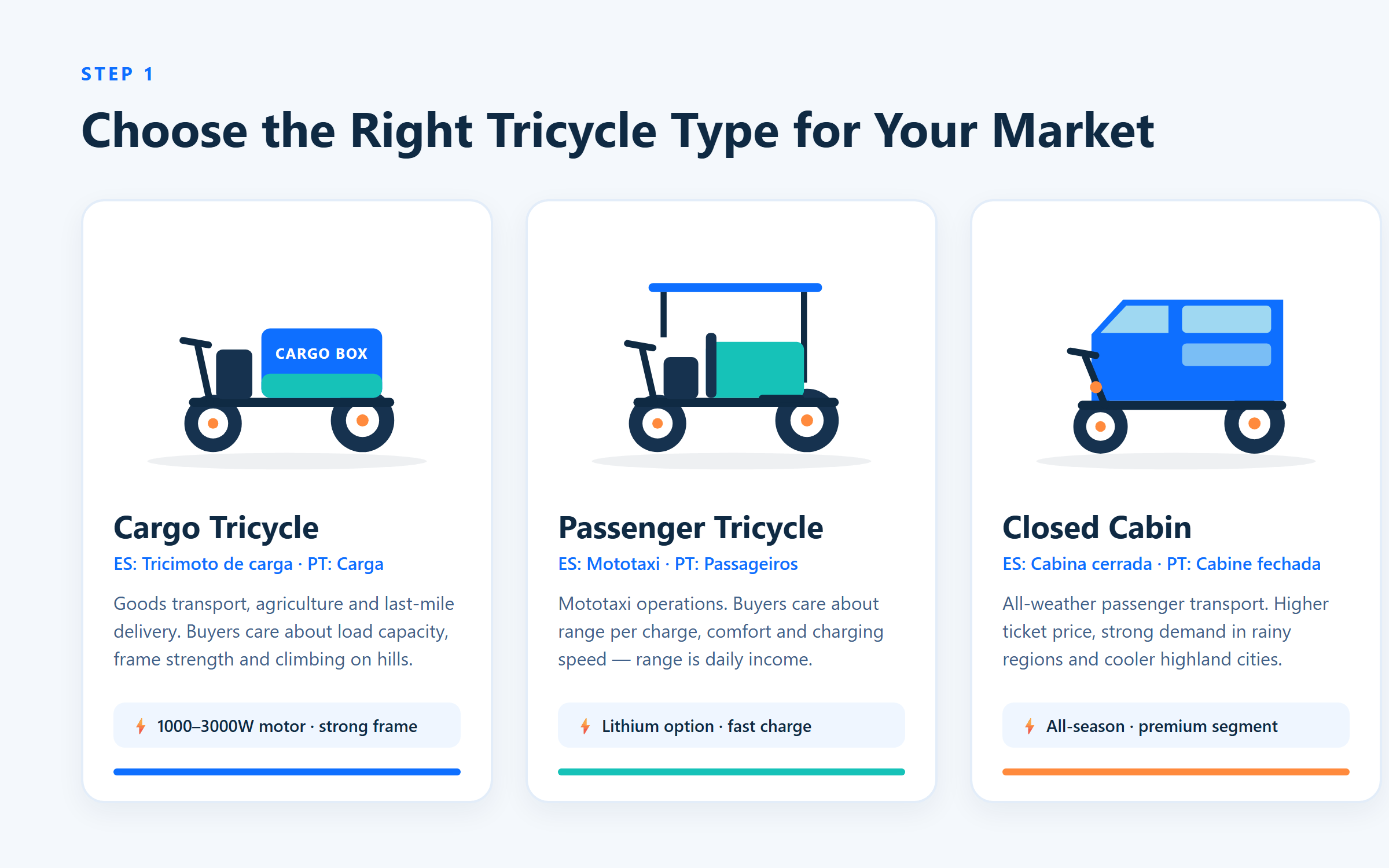
The biggest mistake new importers make is choosing a model based on price instead of market fit. The three main categories serve very different buyers:
- Cargo tricycles — for goods transport, agriculture, and last-mile delivery. Buyers care about load capacity, frame strength, and climbing ability on hills (important in Andean cities like Quito or Bogotá).
- Passenger tricycles — for mototaxi operations. Buyers care about range per charge, comfort, and charging speed, because range is literally daily income.
- Closed-cabin models — all-weather passenger transport. Higher ticket price, but strong demand in cities with rainy seasons and in cooler highland regions.
Three specs decide whether your customers will love or hate the vehicle:
- Motor power: typically 1000W–3000W for cargo use. Underpowered motors fail on hills and heavy loads — a real issue in steep Andean cities.
- Battery type: lithium vs lead-acid (see the tip in Step 2 — this choice changes your whole cost structure).
- Voltage system: 60V or 72V. Higher voltage handles heavy loads with less stress on components.
Match the spec to the road conditions and workload of your market, not to the lowest price on Alibaba.
Step 2: Find and Verify a Reliable Chinese Supplier
When you import electric tricycles from China, supplier verification should come before price comparison. You’ll meet two kinds of sellers: real manufacturers and trading companies. Neither is automatically bad, but you should always know which one you’re talking to — it affects price, customization, and after-sales.
Verify before you send any money:
- Business license and export record — ask for the company’s license and check how many years they’ve been exporting.
- Factory proof — request a live video factory tour, or use a third-party inspection service for an on-site audit.
- Real photos and videos — stock renders are a red flag. Ask for today’s workshop video.
- Export experience to your country — a supplier who already ships to Callao, Cartagena, or Santos knows your customs paperwork and port processes.
- References — ask to speak with an existing distributor in a nearby market.
Consider adding your own factory visit photo here — nothing builds trust with buyers like real production photos.
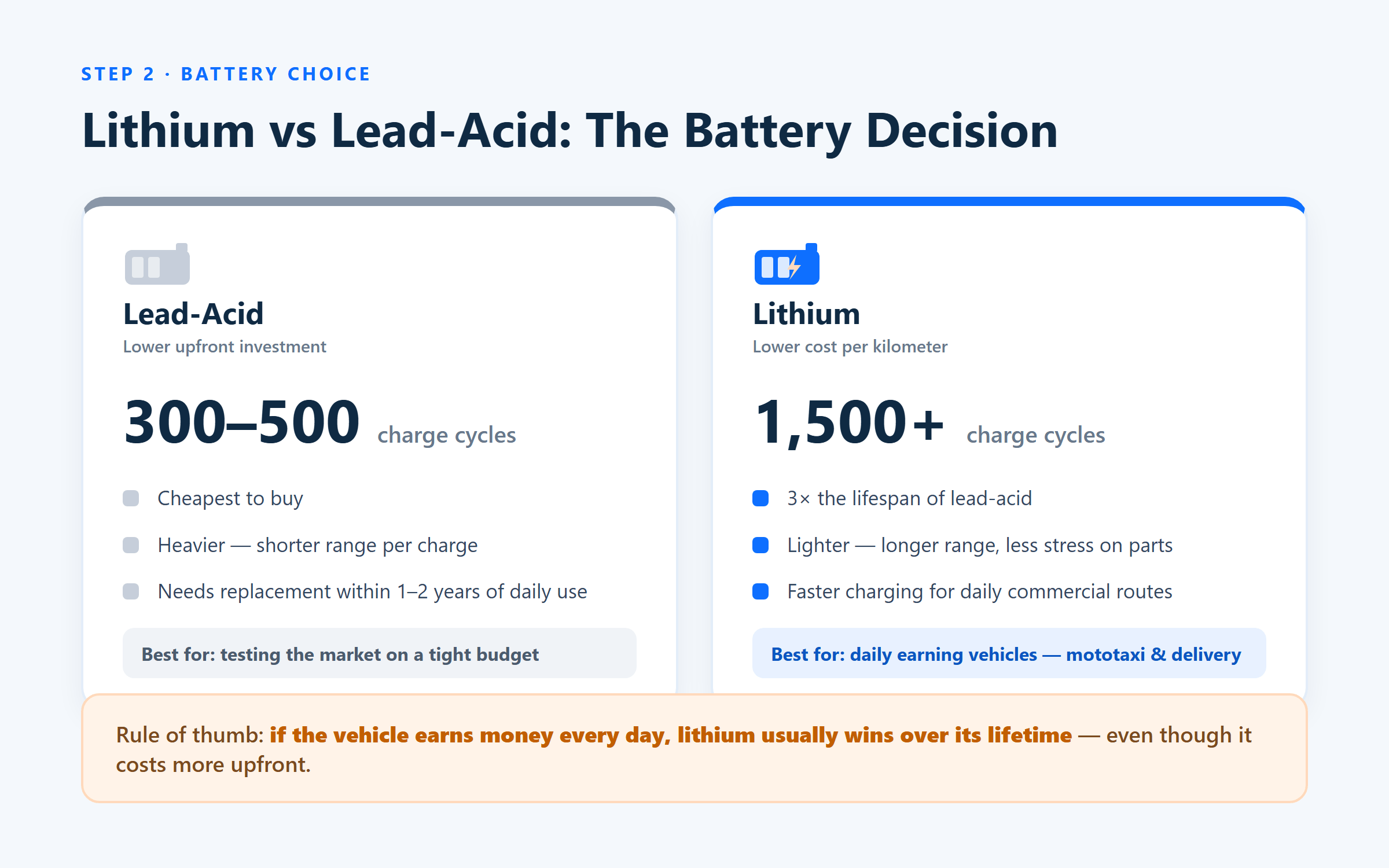
Battery tip: lead-acid is cheaper upfront but lasts roughly 300–500 charge cycles. Lithium lasts 1,500+ cycles, weighs less, and gives better range — usually the smarter choice for passenger tricycles where drivers charge daily and range is money.
Step 3: Understand MOQ and What Actually Drives Price
Most manufacturers set the minimum order quantity (MOQ) at one container — a 40HQ container is the common starting point for dealers, though sample orders are usually possible for testing the market first.
What actually moves the price:
- Battery type and capacity (lithium costs more upfront, saves money over the vehicle’s life)
- Motor power and controller grade
- Order quantity — container-level orders unlock real factory pricing
- Customization — your logo, color, seat configuration, or spec changes
When comparing quotes between suppliers, make sure you’re comparing identical specs. A quote with a smaller battery or a weaker controller can look 15% cheaper and be a far worse deal.
Step 4: Payment Terms — Protect Yourself
The standard structure in this industry is 30% deposit with order, 70% balance before shipment (T/T bank transfer).
Practical rules:
- Never pay 100% upfront to a supplier you haven’t audited.
- Use Alibaba Trade Assurance for first orders if the supplier supports it.
- For larger repeat orders, a Letter of Credit (L/C) through your bank adds protection.
- Always pay into the company account, never a personal account. A request for personal-account payment is one of the clearest fraud signals in this industry.
Step 5: Inspection Before Shipment
Once production finishes, inspect before the balance payment. Your options, from cheapest to most thorough:
- Video inspection — the supplier shows you units running, lights working, batteries charging. Free, but limited.
- Third-party inspection — companies like SGS or QSI check build quality, specs match, and packaging for a few hundred dollars. Worth it for your first orders.
- Visit in person — makes sense combined with placing your next order.
Check at minimum: paint and welding quality, motor and controller brands match the contract, battery pack labels match the specification, and every unit is test-ridden.
Step 6: Shipping — Routes, Terms and Container Loading
For distributors planning to import electric tricycles from China, container loading efficiency directly affects the landed cost per unit. Two terms you’ll live with:
- FOB (Free on Board): the price covers the vehicle delivered to the Chinese port. You arrange and pay for ocean freight, insurance, and destination charges. Usually cheaper if you have a freight forwarder.
- CIF (Cost, Insurance, Freight): the price includes shipping to your port. Simpler, but compare the total — suppliers’ freight rates are sometimes higher than your forwarder’s.
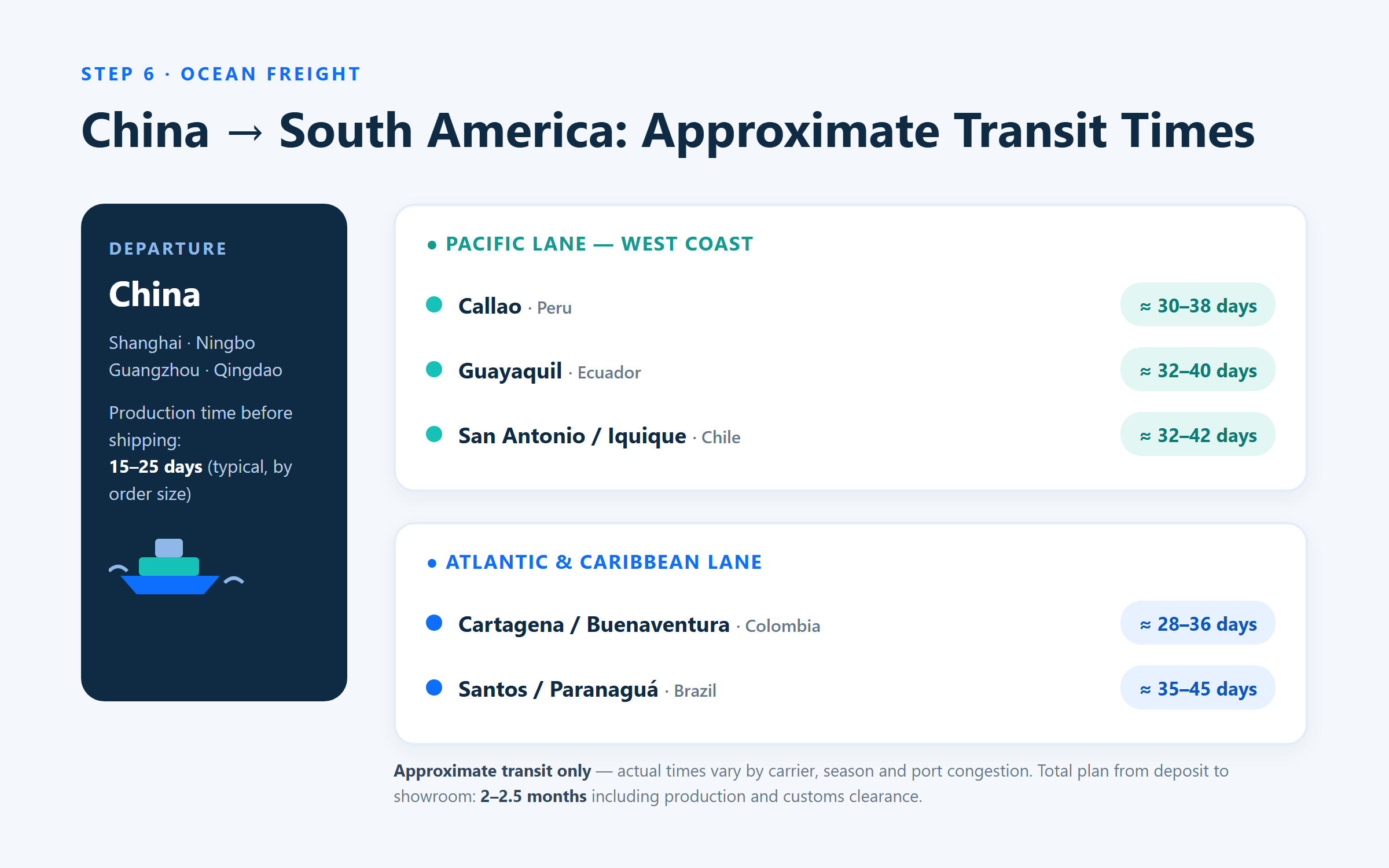
Approximate ocean transit times from China (they vary by carrier and season):
- Colombia — Cartagena or Buenaventura: about 28–36 days
- Peru — Callao: about 30–38 days
- Ecuador — Guayaquil: about 32–40 days
- Chile — San Antonio or Iquique: about 32–42 days
- Brazil — Santos or Paranaguá: about 35–45 days
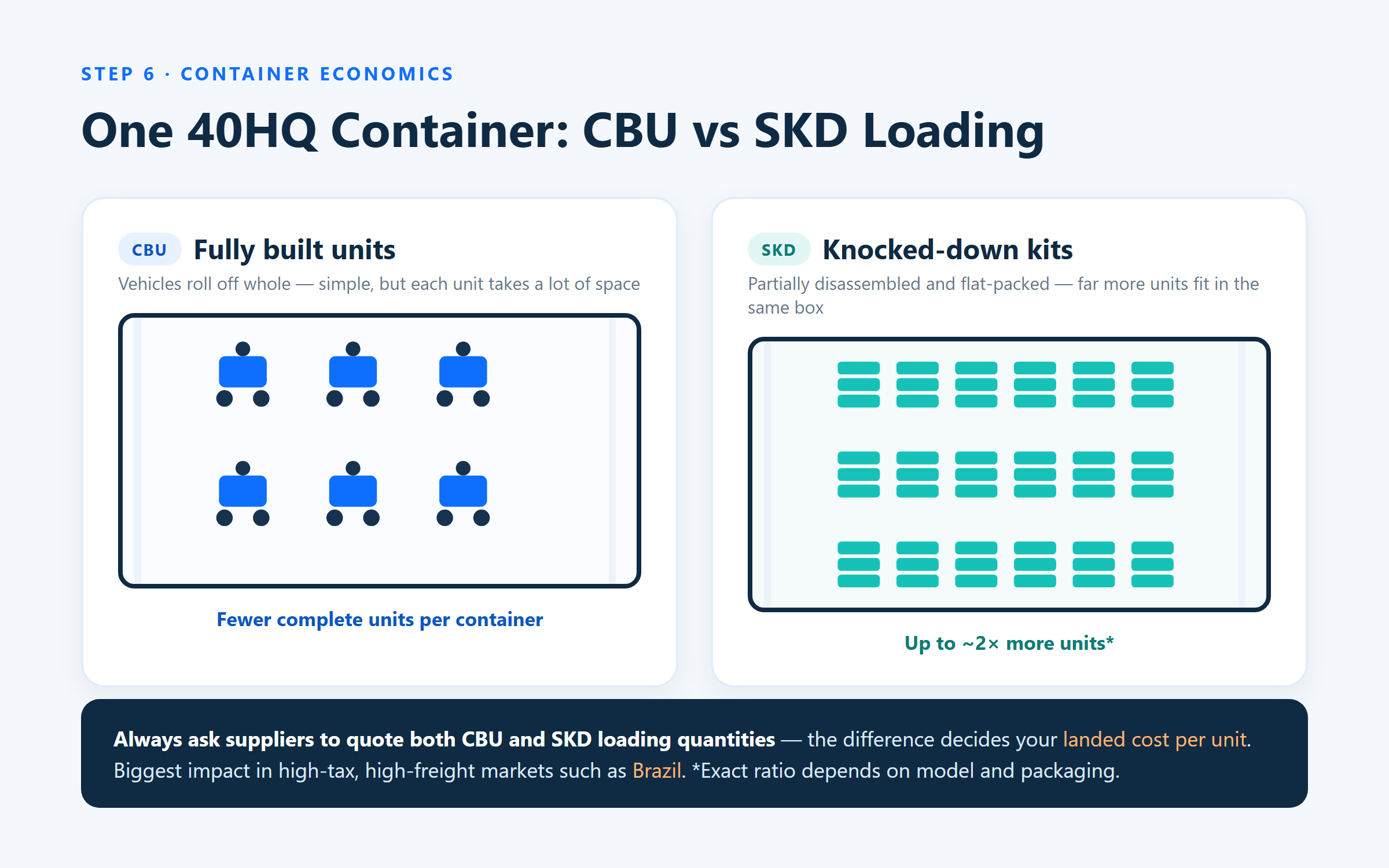
One detail that changes your unit economics is knock-down (SKD) packing. Tricycles shipped partially disassembled take far less container space, so one 40HQ container can carry significantly more units than fully-built ones.
Ask every supplier how many units they can load per 40HQ in CBU (fully built) and in SKD. The difference can significantly affect your landed cost per unit, especially in high-tax markets like Brazil.
Step 7: Customs, Duties and Trade Agreements
Before you import electric tricycles from China, confirm the latest tariff, certification, and customs requirements with a local customs broker. This is where South America differs the most from other markets — and where knowing the rules can save you thousands. Always confirm details with a local customs broker before you order, but here’s the landscape:
- Chile: the China–Chile Free Trade Agreement means most Chinese goods enter with very low or zero duty when accompanied by a certificate of origin — one of the smoothest entry points in the region.
- Peru: the China–Peru FTA works similarly; with a valid certificate of origin, duty on many product lines is reduced or eliminated.
- Ecuador: the China–Ecuador FTA (in force since 2024) is phasing in tariff reductions on a wide range of goods.
- Colombia: no FTA with China — standard MFN duties apply plus 19% IVA, and importers must be registered with DIAN. Calculate the full landed cost carefully.
-
Brazil: the most complex tax structure in the region — import duty,
IPI, PIS/COFINS and state ICMS can all affect landed cost. Importers should review the
latest requirements with the
Receita Federal
and work with an experienced customs broker before placing an order.
In every case: your Bill of Lading and packing list must match exactly what’s in the container — small mismatches cause expensive delays at port. And budget duties, VAT, and port charges into your landed-cost calculation from day one.
Step 8: After-Sales and Spare Parts — Where Suppliers Actually Differentiate
Before you import electric tricycles from China, confirm your spare-parts plan, warranty terms, and after-sales support with the supplier. Here’s what separates a supplier from a partner. Before committing, ask:
- Spare parts supply: can you order wear parts (tires, controllers, chargers, batteries) anytime, and how fast do they ship?
- Technical support: do they provide repair manuals, wiring diagrams, and video guidance for your mechanics?
- Warranty terms: what’s covered, for how long, and how are claims handled?
- Parts recommendation for your first container: experienced suppliers help you stock the right spare parts alongside vehicles — this alone can decide your service reputation in the first year.
A cheap vehicle with no parts backup will destroy your brand in the local market within months.
Common Mistakes First-Time Importers Make
- Choosing the cheapest quote instead of comparing identical specs
- Paying 100% upfront or into a personal account
- Skipping pre-shipment inspection to save a few hundred dollars
- Ignoring knock-down packing — and paying far more per unit in freight
- Not budgeting duties, VAT, and port charges into the landed cost
- Ordering vehicles with no spare parts plan
Frequently Asked Questions
What is the MOQ for importing electric tricycles from China?
Most manufacturers work with container-level orders (a 40HQ is typical), and most accept smaller sample orders so you can test your market before committing. At Falcon EV we support both sample orders and full container programs.
How much does it cost to import an electric tricycle?
The FOB price depends mainly on battery type, capacity, and motor power — which is why prices between suppliers can differ widely. Ask for a quotation based on identical specifications, then add freight, duties, VAT, and clearance to get your true landed cost. Contact us for a current price list.
Lithium or lead-acid battery — which is better for my market?
Lead-acid wins on upfront cost; lithium wins on lifespan (1,500+ cycles vs 300–500), weight, and range. For mototaxi operations where the vehicle earns money daily, lithium usually delivers a lower cost per kilometer over its life.
How long does shipping take from China to South America?
Approximately 28–36 days to Cartagena, 30–38 days to Callao, 32–40 days to Guayaquil, 32–42 days to San Antonio, and 35–45 days to Santos — plus production time (usually 15–25 days depending on the order) and port clearance on both ends. Plan 2–2.5 months from deposit to vehicles in your showroom.
What about import duties in Chile, Peru, Ecuador, Colombia and Brazil?
Chile and Peru both have free trade agreements with China, so goods shipped with a certificate of origin can enter at very low or zero duty.
Ecuador’s FTA with China took effect in 2024 with phased tariff reductions.
Colombia applies standard duties plus 19% IVA, and Brazil has the region’s most complex tax stack — there, a local customs broker is essential. Rules do change, so always confirm current rates before ordering.
Can I order electric tricycles with my own brand?
Yes. Through our OEM/ODM service you can customize branding, colors, seat layout, and specifications — most distributors start with their logo and brand colors on proven models.
Start with a Sample Order
You don’t need to bet a full container on your first import. The smartest path: order samples, test them with real drivers in your market, then scale to a container with confidence.
Request a quote and current price list → — or message our export team directly on WhatsApp: +86 188 1118 8769.
Written by the Falcon EV export team — 10+ years exporting electric tricycles, motorcycles, and golf carts to 50+ markets across Latin America.